
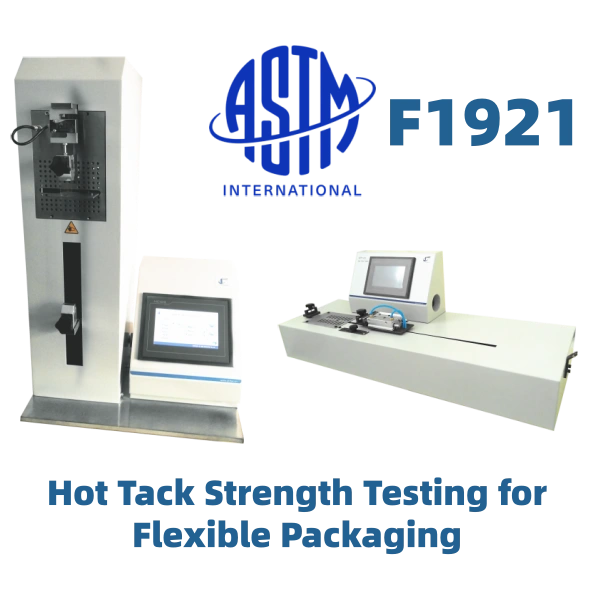
Understanding ASTM F1921 and Its Role in Seal Integrity
ASTM F1921 defines standardized procedures to evaluate the rezistență la aderență la cald of thermoplastic films and flexible webs immediately after heat sealing. This property is critical because seals often face mechanical stress before cooling during high-speed packaging operations such as form-fill-seal (FFS).
Unlike conventional seal strength tests, ASTM F1921 focuses on seal performance in the molten or semi-molten state, providing insight into real production conditions. Engineers and quality control teams rely on ASTM F1921 to compare materials, optimize sealing parameters, and prevent premature seal failure.
What is Hot Tack Strength?
Hot tack strength measures the force required to separate a heat seal while it is still hot. This parameter directly affects packaging efficiency and product safety.
Why Use a Hot Seal Strength Tester?
A hot seal strength tester performs controlled sealing and immediate tensile separation under defined conditions. It ensures:
- Accurate simulation of industrial sealing processes
- Repeatable and standardized results
- Reliable comparison between materials
Hot Tack Strength Test for Plastic Film Applications
The hot tack strength test for plastic film is widely applied in:
- Multi-layer barrier films
- Laminated packaging structures
- Medical and pharmaceutical packaging
It helps determine the seal initiation temperature (SIT) and optimal sealing window, which are essential for process optimization.
Hot Tack Test Methods Defined in ASTM F1921
ASTM F1921 includes two primary test methods, both designed to measure seal strength immediately after sealing:
ASTM F1921 Method A (Fixed Delay)
- Measures hot tack strength at predefined cooling times
- Generates a cooling curve of seal strength versus time
- Suitable for detailed material characterization
ASTM F1921 Method B (Variable Delay)
- Applies a selected delay time before testing
- Records the maximum force during separation
- Ideal for process-oriented testing and quick comparisons
Both methods involve:
- Controlled sealing temperature, pressure, and dwell time
- Automated separation of the sealed specimen
- Measurement of peel force until failure
Key Parameters in Hot Tack Test
To achieve reliable ASTM F1921 results, operators must carefully control:
Sealing Temperature
Typically tested across a range to generate a hot tack curve. The curve begins near the seal initiation temperature and increases incrementally.
Timp de staționare
- ≤25 µm films: ~0.5 s
- 25–64 µm films: ~1.0 s
- 64 µm films: ~2.5 s
Presiunea de etanșare
Usually maintained between 15–30 N/cm², ensuring proper interface bonding.
Separation Speed
Affects measured force and must remain consistent for comparable results.
Failure Modes Observed in ASTM F1921 Testing
Recording failure modes is essential for interpreting results. Common modes include:
- Adhesive failure at the seal interface
- Cohesive failure within the material
- Delamination of layers
- Material break or elongation
These observations help identify whether failure originates from seal weakness or material structure issues.
Choosing the Right Hot Seal Strength Tester
A reliable hot seal strength tester must meet ASTM F1921 requirements and provide stable, repeatable results.
Cell Instruments offers advanced solutions such as the Tester Hot Tack (HTT series), designed for precision and flexibility:
- Sistem controlat de PLC ensures consistent automation
- High-accuracy temperature control (±0.2°C) guarantees repeatability
- Supports both Method A and Method B testare
- Wide speed range accommodates various materials
- Integrated safety and calibration features
These capabilities allow laboratories and manufacturers to perform comprehensive hot tack strength test for plastic film with confidence.
Întrebări frecvente
1. What is the difference between hot tack strength and seal strength?
Hot tack strength measures seal integrity immediately after sealing, while seal strength evaluates fully cooled seals.
2. Why is ASTM F1921 important for packaging?
It simulates real packaging conditions where seals undergo stress before cooling, helping prevent failures.
3. Which industries rely on ASTM F1921 testing?
Food packaging, pharmaceuticals, medical devices, and flexible packaging industries widely use this standard.
4. How do I select between Method A and Method B?
Use Method A for detailed analysis and cooling curves; choose Method B for faster, process-oriented testing.
5. What factors most influence hot tack strength?
Sealing temperature, dwell time, pressure, and material composition significantly affect results.